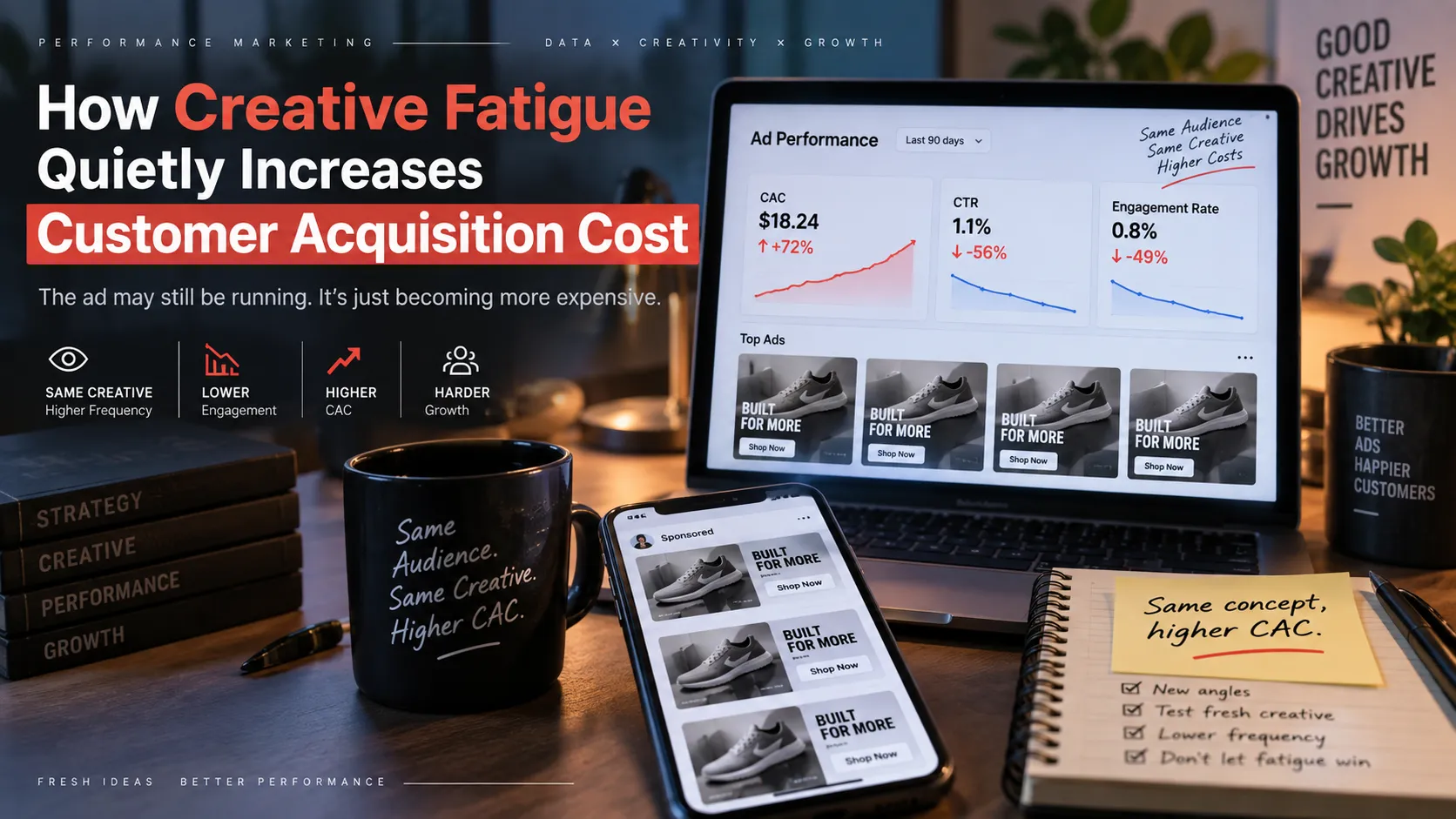
Most teams find out about creative fatigue the hard way — when ROAS collapses, spend stops scaling, or a former winner suddenly stops producing purchases. By then, the damage has already been compounding for weeks.
That’s the wrong moment to notice it. Creative fatigue rarely announces itself with a dramatic collapse. It shows up first as a slow, almost invisible drift — a few points of CTR here, a slightly higher CAC there — long before anything looks broken on a dashboard.
This is what makes fatigue dangerous: the ad usually keeps working. It just becomes progressively less efficient at doing so. And an efficiency problem that doesn’t look like a performance problem is exactly the kind of thing that survives three months of reporting before anyone asks why margins feel thinner than they used to.
Creative fatigue is often a margin problem before it becomes an ad-performance problem.
CAC Doesn’t Usually Spike Overnight
Here’s a progression worth sitting with:
- Week 1: CAC = $32
- Week 2: CAC = $35
- Week 3: CAC = $39
- Week 4: CAC = $44
- Week 5: CAC = $51
Nothing in that sequence triggers an alarm. The ad is still converting. ROAS still technically clears the bar. Nobody pulls the creative, because on any single week, the drop looks like noise — a slightly worse auction, a slower week, seasonal softness.
But across five weeks, acquisition cost has risen 59%. That’s not noise. That’s the business quietly losing efficiency in plain sight, because gradual deterioration doesn’t trip the mental alarms that sudden failure does. A creative that stops converting overnight gets pulled immediately. A creative that gets 8% less efficient every week keeps running for months, because each individual week looks defensible.
The Hidden Chain Reaction
Underneath that slow CAC creep is a fairly mechanical chain reaction:
Repeated exposure → lower novelty → weaker attention → lower engagement/CTR → Meta needs more impressions to generate the same clicks → fewer qualified visits per dollar → fewer conversions per dollar → CAC rises.
It isn’t always perfectly linear, and other variables interact with it. But the underlying pattern holds across most accounts: as an audience segment absorbs the same message repeatedly, its marginal response to that message weakens. Engagement signals soften. The audience isn’t gone — it’s just less moved by an idea it has already processed several times.
A useful way to frame the stages:
Attention Decay → Response Decay → Conversion Decay → CAC Inflation
Attention decay happens first — the hook stops earning the same stop-scroll rate it used to. Response decay follows — the people who do watch engage less and click less. Conversion decay comes next — the traffic that does arrive converts at a lower rate, often because the message feels stale even to people encountering the landing page for the first time via a worn-out ad. CAC inflation is simply the financial expression of the first three stages compounding together.
Frequency Is a Symptom, Not the Diagnosis
“Frequency is high, so the ad is fatigued” is one of the most common — and least reliable — shortcuts in paid social.
Frequency on its own tells you almost nothing. It has to be read alongside CTR trend, CPM trend, CAC trend, conversion rate, hook rate, hold rate, spend level, audience size, placement mix, campaign objective, and the time window involved. A high-frequency ad in a large, well-targeted audience can keep performing fine. A low-frequency ad can already be creatively dead if the concept was generic or indistinguishable from everything else in the category — the audience doesn’t need five exposures to tune out an idea it’s seen from three competitors already.
It also helps to separate fatigue into distinct types, because they call for different fixes:
- Exposure fatigue — the audience has simply seen this specific ad too many times
- Message fatigue — the underlying argument has been made too often, regardless of which ad delivered it
- Format fatigue — the style (UGC talking head, meme format, demo) has become predictable across the account
- Concept fatigue — the core idea itself has run its course in this market, and no amount of re-editing revives it
Most “creative refreshes” only address exposure and format fatigue. They leave message and concept fatigue completely untouched — which is why the refresh often buys two good weeks before performance sags right back down.
Fatigue Can Happen Even While You Keep Launching “New” Ads
This is where most teams fool themselves.
Consider a skincare brand’s recent creative output:
- Ad 1: A creator saying, “I finally found the skincare product that fixed my acne.”
- Ad 2: A different creator saying the same thing.
- Ad 3: Same message, new captions.
- Ad 4: Same concept, edited with faster cuts.
- Ad 5: Same testimonial, different hook.
Technically, that’s five creatives launched this month. Strategically, it’s one idea, run five times. Changing the creator, the background, the captions, the music, the first three seconds, or the CTA can genuinely extend a concept’s lifespan — but none of those changes give the market a new reason to care. That distinction — execution fatigue versus concept fatigue — is the difference between a library that looks productive in a content calendar and one that’s actually generating fresh demand signals.
An account can post daily and still be creatively stagnant, because volume was never the variable that mattered. Message diversity was.
Why CAC Rises Before ROAS Fully Breaks
Fatigue erodes unit economics well before a campaign looks “unprofitable” on paper. Take a simple example:
- Average order value: $120
- Gross margin before advertising: $75
At $30 CAC, $45 of contribution margin remains per order. At $45 CAC, that drops to $30. At $60 CAC, only $15 is left.
The campaign is still technically profitable at every one of those CAC levels. But contribution margin has fallen by two-thirds. Nothing in a standard ROAS report captures that erosion clearly, because ROAS can still clear an acceptable threshold while the actual cash left over per sale quietly collapses.
This is why the operating question shouldn’t be “Is this ad still profitable?” A weak ad can limp along profitably for a long time. The sharper question is “Is this ad still as efficient as it should be?” — because efficiency, not raw profitability, is what determines how fast a business can actually scale.
Fatigue Changes What Meta Has to Do to Find the Next Customer
As a creative’s marginal response weakens, the platform doesn’t necessarily “punish” it in some deliberate sense — but the practical effect looks similar. To generate the same volume of conversions from a less responsive creative, the system typically needs more impressions, has to explore into more expensive or less precisely-matched inventory, and spends more to produce equivalent results.
When the creative becomes less productive, media buying becomes more expensive. This is where creative and media buying economics are inseparable — a media buyer working with fatigued creative is fighting rising costs that no bid strategy or campaign structure change can fully offset, because the underlying input feeding the system has degraded.
Early Warning Signals Worth Tracking
A practical fatigue early-warning system looks for trends, not single-day blips:
- CTR drifting downward over consecutive weeks, without a dramatic crash
- CAC rising while spend stays flat — a clear sign of eroding efficiency, not scaling pressure
- Frequency rising while conversion volume stays flat — the same audience seeing more impressions without proportional response
- Hook rate falling — the opening is losing its ability to earn attention
- Hold rate weakening — viewers stop watching before the message lands
- CVR declining — traffic quality or persuasive power is slipping
- Winning ads needing more spend to produce the same conversions — a subtle efficiency tax hiding inside “still working” creative
- New variants failing to restore performance — often the clearest sign the issue is concept fatigue, not execution fatigue
Any one of these in isolation is easy to explain away. Several of them trending together over multiple weeks is a pattern worth acting on.
Fatigue Isn’t the Answer to Every CAC Problem
It’s tempting to blame every CAC increase on creative fatigue. That’s a mistake in the other direction. CAC can rise because of seasonality, increased auction competition, price changes, offer deterioration, landing page issues, inventory problems, tracking changes, audience shifts, category-wide saturation, macroeconomic conditions, or promotional cycles that have nothing to do with the ad itself.
A simple diagnostic pattern helps separate these:
- CTR falls, CVR stays strong → investigate creative first
- CTR stays strong, CVR drops → investigate landing page, offer, message-to-page alignment, or traffic quality
- CPM rises, CTR and CVR remain stable → auction conditions are likely the bigger factor
- Old creatives weaken, new concepts restore efficiency → creative fatigue becomes a strong, evidence-backed explanation
Fatigue is diagnosed through patterns across metrics, not declared from a single number.
The Fix Isn’t “Refresh Creative Every Two Weeks”
Arbitrary creative-refresh calendars are a blunt instrument. Creative lifespan varies by spend level, audience size, brand awareness, category, market maturity, the strength of the underlying concept, and seasonality — a rigid two-week cycle will retire strong concepts too early and let weak ones run too long.
The better model is a continuous pipeline:
Research → Customer insight → Angle → Concept → Hook → Execution → Launch → Measurement → Fatigue monitoring → Iteration or replacement
Creative production in this model is proactive — concepts are already in development before the current winner shows signs of decay — rather than reactive, where a new brief only gets written once CAC has already climbed uncomfortably high.
Building a Creative Fatigue Defense System
A practical, layered defense:
Layer 1 — Maintain concept diversity. Continuously test different problems, desires, benefits, objections, mechanisms, personas, and awareness levels — not just new edits of the same one.
Layer 2 — Extend winning concepts through multiple executions. Once a concept proves itself, stretch its life through UGC, founder-led formats, demonstrations, testimonials, statics, comparisons, product demos, voiceover, and story-based structures.
Layer 3 — Develop new concepts before the current winner dies. Don’t wait for CAC to spike before writing the next brief. The pipeline should always have challengers in production.
Layer 4 — Track decay curves. Monitor how each concept’s performance changes across spend, impressions, frequency, and time, and build a real sense of how long your strongest concepts typically last before response weakens.
Creative Velocity Only Matters With Learning Attached
Creative velocity without strategic learning is just production volume. Thirty ads produced in a month means nothing if they’re all variations on one exhausted concept — that’s activity, not progress.
A more useful definition: creative velocity is the speed at which meaningful new market hypotheses get turned into testable advertising — not the number of files exported out of an editing timeline. An account producing five genuinely different concepts a month is often in a stronger position than one producing thirty executions of the same idea.
Why This Gets More Important at Scale
At low spend, one strong ad can survive for a long time, because it isn’t being shown to enough of the addressable audience to exhaust it quickly. At higher spend, the market consumes creative far faster — the same concept reaches saturation in a fraction of the time.
Creative production must scale with media spend. A brand trying to push spend up without a proportional increase in creative output and concept diversity will hit an invisible ceiling — not because the audience ran out, but because the ideas being shown to that audience ran out first. You cannot sustainably scale media faster than your ability to create new demand signals.
Fatigue Looks Different Across Business Models
A DTC skincare brand’s fatigue often shows up as CTR decay on UGC testimonial formats after heavy exposure to the same “before/after” narrative. A supplements brand sees it in declining hold rate once “here’s why this ingredient works” has been explained the same way too many times. A SaaS company sees it in falling CVR on demo-request ads once the same feature-benefit framing has circulated through its narrow addressable market. A high-ticket service business sees it in rising cost-per-lead once the same case study has been the sole proof mechanism for months. A local lead-gen business sees it in frequency climbing fast within a small geographic audience, with no new angle to reach the people who weren’t moved the first time.
The common failure across all five is the same: launching the same offer with five different creators, five different captions, five different hooks — while the underlying reason to buy never changes. The stronger response, in every case, is introducing genuinely new reasons to act: cost savings, time savings, identity, problem agitation, a new mechanism, a comparison, a different proof point, or a specific objection handled head-on. Message diversity — not execution volume — is what reopens audience response that looked exhausted.
The Real Reframe
Creative fatigue isn’t “our ad is getting old.” It’s more precise than that: the market is responding less efficiently to the ideas currently being shown to it.
The fix was never endless cosmetic variation. It’s a system capable of continuously producing new angles, new messages, new concepts, new proof, and new reasons to believe and act — built before the current winner needs replacing, not scrambled together after CAC has already climbed.
Your CAC may not be rising because Meta became more expensive. It may be rising because your creative became less productive.
Creative fatigue is the silent tax paid whenever media spend moves faster than creative strategy.