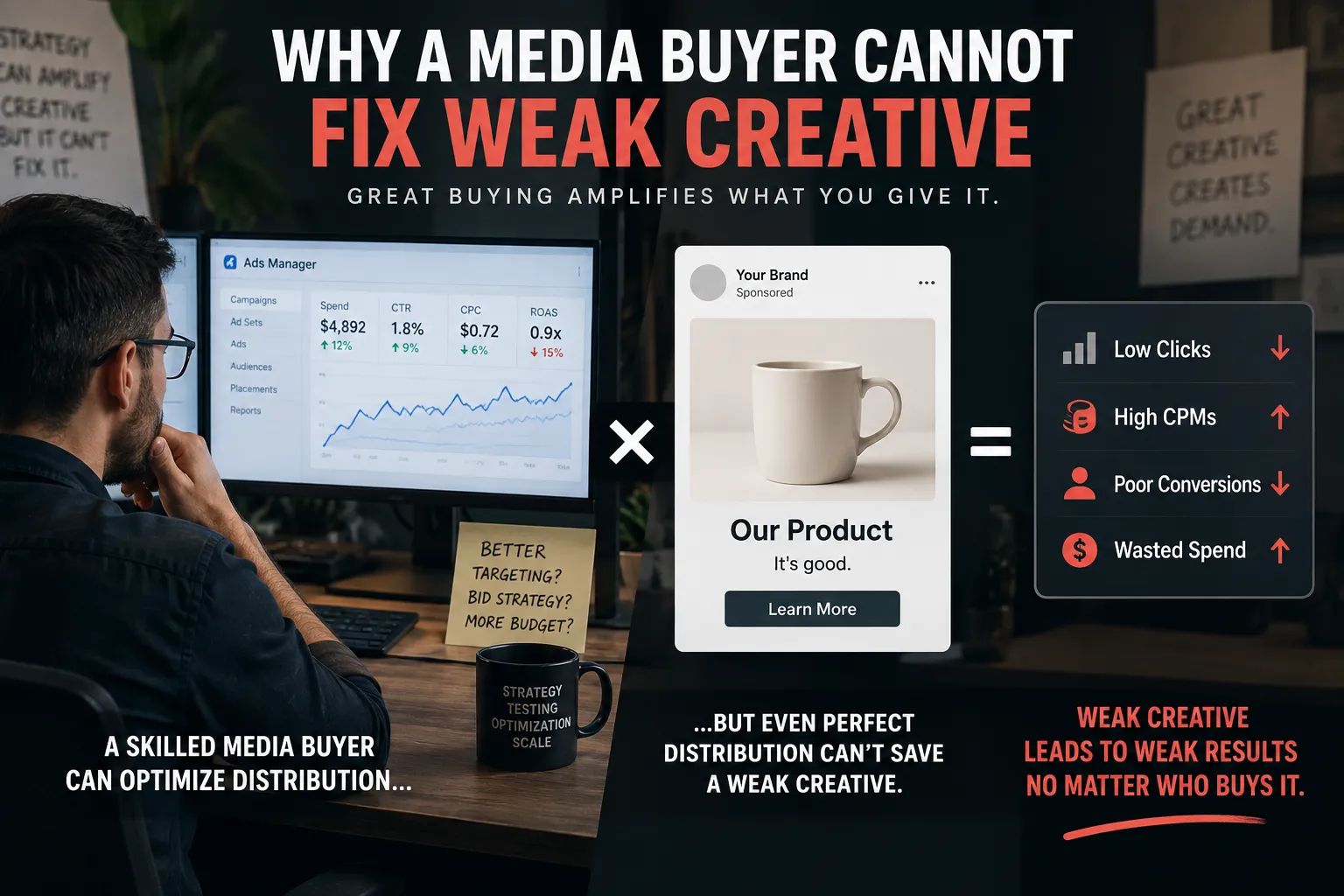
Performance drops. The response is almost always immediate: change the audience, duplicate the campaign, switch the bidding strategy, increase budget, decrease budget, test a new placement, toggle Advantage+ on, toggle it back off.
The team keeps adjusting the machinery. Almost nobody stops to ask: would anyone actually want to watch this ad? Or: is this message still compelling enough to create demand?
When performance drops, the easiest thing to change is often the campaign. That does not mean the campaign is the problem. A skilled media buyer can meaningfully improve how efficiently a message gets distributed. They cannot make a weak message persuasive — and confusing those two jobs is one of the most expensive habits in paid acquisition.
What Media Buying Actually Controls
Give media buyers their proper due first. A skilled media buyer influences where budget goes, how aggressively campaigns scale, how audiences get reached, how tests are structured, how signals get interpreted, and how inefficient spend gets cut. That’s genuinely valuable, specialized work — accounts with poor media buying leave real money on the table regardless of how good the creative is.
But media buying’s domain is fundamentally distribution and allocation. Creative’s domain is attention, relevance, message, desire, differentiation, belief, and persuasion. Call this the difference between distribution efficiency and persuasion efficiency. A strong account needs both operating well — but they are not interchangeable, and one cannot substitute for the other no matter how sophisticated it gets.
Media Buyers Optimize Signals — Creative Creates Them
Creative shapes thumb-stop behavior, hook rate, hold rate, CTR, engagement quality, and conversion intent. The media buyer then works with what comes after — CPA, CAC, ROAS, conversion rate, spend efficiency — and allocates budget based on those downstream signals.
A media buyer cannot optimize signals that the creative never produces. If the ad earns no attention and no real intent, there’s very little useful performance data to scale in the first place. Sophisticated optimization applied to a weak signal just produces a more efficiently distributed version of nothing.
Targeting Cannot Rescue Irrelevance
“We just need to find the right audience” is one of the most common — and most misleading — explanations for underperformance. Better targeting can absolutely put an ad in front of more relevant people. But even the perfect prospect can ignore a boring hook, a generic claim, or a message they’ve already heard a hundred times from a hundred competitors.
“Looking to grow your business? We offer full-service digital marketing solutions” can reach an exactly qualified founder and still earn no attention, because there’s nothing in it worth stopping for. “Your Meta Ads may not have a targeting problem. Your creative may have stopped giving the market new reasons to buy” reaches the same founder with something that actually implicates their current situation. Perfect targeting cannot make an irrelevant message relevant.
The Algorithm Finds People. It Doesn’t Invent Your Argument
Meta’s delivery system has genuinely become very good at finding people statistically likely to respond, based on the signals it has available. What it does not decide is which pain to lead with, which desire matters most, which objection needs neutralizing, what makes the product actually different, or why the customer should care right now. Those remain strategic creative decisions no algorithm makes on a brand’s behalf.
The algorithm can optimize distribution. It cannot write your value proposition for you. Treating delivery optimization as a substitute for message development asks the platform to do a job it was never built to do.
Weak Creative Makes Media Buying Look Worse Than It Is
A creative bottleneck frequently surfaces disguised as a media buying problem: rising CAC, weak CTR, limited scale, volatile ROAS, poor prospecting performance, heavy retargeting dependency, constant campaign restructuring. The media buyer can end up looking ineffective simply because the account has very few genuinely strong assets to allocate spend toward in the first place.
The analogy holds well: a world-class portfolio manager cannot generate strong returns from a portfolio made entirely of weak assets. A media buyer cannot allocate their way into growth if every creative asset is weak. The skill of the allocator was never the constraint — the quality of what’s available to allocate was.
The Performance Chain
A simple model makes the dependency clear: Creative → Attention → Click → Qualified Visit → Conversion → Revenue, running alongside Media Buying → Distribution → Spend Allocation → Reach → Scale, feeding into Landing Page/Offer → Conversion Efficiency. When creative fails near the top of that chain, every stage below it inherits less opportunity to work with, no matter how well the later stages are run.
A simple illustration: 100,000 impressions, same media budget, same audience, same landing page. Creative A pulls a 0.5% CTR — 500 clicks. Creative B pulls 1.5% — 1,500 clicks. CTR alone doesn’t determine profitability, but Creative B hands the rest of the funnel three times the raw opportunity to convert, purely from the creative layer. No amount of downstream optimization recovers the 1,000 clicks Creative A never generated.
Media Buying Reduces Waste. It Doesn’t Create Desire
Media buying can help avoid overspending, poor placements, weak tests, inefficient allocation, and premature scaling. That’s real, valuable risk reduction. But desire itself gets created through problem relevance, aspirational outcomes, emotional tension, mechanism, differentiation, proof, and offer structure — none of which live inside a campaign’s settings.
Media buying manages opportunity. Creative creates motivation. An account can be running an immaculately structured campaign around a message nobody wants to hear, and the structure will not compensate for that.
Campaign Restructuring Often Buys Relief, Not a New Engine
The pattern is familiar: performance weakens, the campaign gets duplicated, performance briefly improves, and the team concludes the structure was the actual problem. Then performance weakens again a few weeks later.
Some of that bounce is real — auction variance, fresh delivery signals, and short-term audience effects genuinely produce temporary lift. But if the underlying message is still tired, the improvement rarely holds. A new campaign can reset delivery. It cannot reset market interest in a tired idea.
Creative Fatigue Is Where Media Buying Leverage Collapses
A former winning ad gradually shows falling CTR, rising CAC, climbing frequency, and shrinking incremental conversion volume. At that point the media buyer can reduce spend, rotate creative, reallocate budget, and expand audiences — genuinely useful moves that can extend the runway. But eventually the account needs something more fundamental than a new caption or a fresh campaign shell. It needs a new angle, a new concept, new proof, or a new reason to buy. You cannot budget-optimize your way out of message fatigue.
Sophistication Can Hide the Creative Problem — Temporarily
Sophisticated accounts can sometimes stretch genuinely weak creative surprisingly far, through retargeting, high-intent segments, existing brand demand, or aggressive promotional periods. This can make an account look healthier than the underlying creative actually justifies. The gap shows up the moment the business tries to expand into cold prospecting — performance that looked fine suddenly breaks, because retargeting was monetizing demand that already existed, not generating any. Retargeting can monetize existing demand. Creative is what usually creates new demand.
What Weak Creative Actually Looks Like
Weak creative is not synonymous with poor production value — it can be beautifully shot, expertly edited, and still fail because it’s generic, unclear, undifferentiated, overly product-centric, mismatched to the audience’s awareness level, missing proof, or simply repeating a claim the market has already absorbed from three competitors.
Weak DTC: “Premium ingredients. Made for your lifestyle.” Stronger: “If your protein shake leaves you hungry an hour later, protein may not be the only thing missing.” Weak SaaS: “Transform productivity with AI.” Stronger: “Your sales team loses more time updating the CRM than talking to prospects.” Strategy determines whether an ad is worth watching well before production quality ever enters the conversation.
Creative and Media Buying Shouldn’t Operate in Silos
The media buyer sees CAC trends, spend curves, audience behavior, performance decay, and scaling limitations. The creative strategist interprets those signals alongside hook performance, message patterns, customer research, awareness levels, and fatigue indicators. Together, they’re better positioned to answer what should stop, what should scale, what should iterate, and what needs full replacement.
This is a Performance Creative Feedback Loop: Creative Hypothesis → Launch → Media Distribution → Performance Data → Creative Learning → Next Hypothesis. The best media buying teams don’t just buy media. They feed the creative system intelligence — treating campaign data as market research, not just a scoreboard.
Media Buying Can’t Fix a Weak Offer Either
Worth stating plainly: sometimes creative isn’t the bottleneck either. A media buyer cannot permanently solve an unattractive price, weak differentiation, poor product-market fit, thin margins, a broken landing page, or a clunky sales process. Paid media amplifies the economics that already exist in the business — it doesn’t repair them. Ads do not fix a weak business model. They expose it faster, which is exactly why “just run more ads” is bad advice for a business with an underlying offer problem.
Diagnosis: Media Problem, Creative Problem, or Something Else
Investigate creative when CTR consistently weakens, hook rate is poor, multiple distinct audiences respond similarly poorly, new concepts restore performance that budget changes couldn’t, or the account can’t scale despite a stable landing-page conversion rate.
Investigate media buying when strong creative isn’t receiving proportional spend, budget allocation looks inefficient, campaigns are needlessly fragmented, tests can’t exit the learning phase due to structural issues, or scaling decisions look inconsistent even though the creative itself performs well.
Investigate the landing page or offer when CTR is strong but conversion rate is weak, traffic quality looks genuinely good, the message stops matching after the click, or resistance clearly centers on price rather than attention. Diagnosis comes from patterns across the funnel, not from one metric in isolation.
Optimization vs. Creation
Media buying is primarily an optimization discipline: how do we get more from what already works? Performance creative is partly a creation discipline: what new thing could work next? Both are genuinely necessary — but optimization eventually hits a hard ceiling once there are no new winning creative inputs left to allocate toward. Optimization extracts value. Creative creates new sources of value to extract. An account that only optimizes will eventually run out of anything worth optimizing.
Scaling Eventually Becomes a Creative Problem
At low spend, one or two strong ads can carry an account for a long stretch. As spend grows, more people see the same ads, concepts fatigue faster, increasingly marginal audience segments get reached, and more message diversity becomes necessary just to maintain the same efficiency. The higher the spend, the more important the creative system becomes — new angles, new awareness levels, new proof, new formats. Media spend can scale faster than creative production, but not sustainably.
The Media Buyer Leverage Test
Before restructuring a campaign, it’s worth asking directly: is the ad earning attention? Is the message relevant? Is CTR healthy against account history? Is click quality strong? Is the creative actually differentiated? Is the offer compelling? Does the landing page continue the ad’s argument? Is there real concept diversity in the account, or one idea in different outfits? Are winning creatives getting proportional spend?
Then the sharpest question of all: if nothing about the campaign changed and only the creative improved, would performance likely improve? If the honest answer is yes, the bottleneck sits upstream of anything a media buyer can fix.
The Real Division of Labor
A media buyer’s job was never to rescue weak advertising. Their job is to distribute, test, allocate, and scale strong marketing ideas as efficiently as possible. The creative team’s job is to continuously produce ideas worthy of that distribution in the first place.
A media buyer can make a good ad work harder. They cannot make a weak ad worth watching. Media buying decides where your money goes. Creative decides whether the market gives anything back for it — and no amount of campaign optimization ever closes that gap on its own.