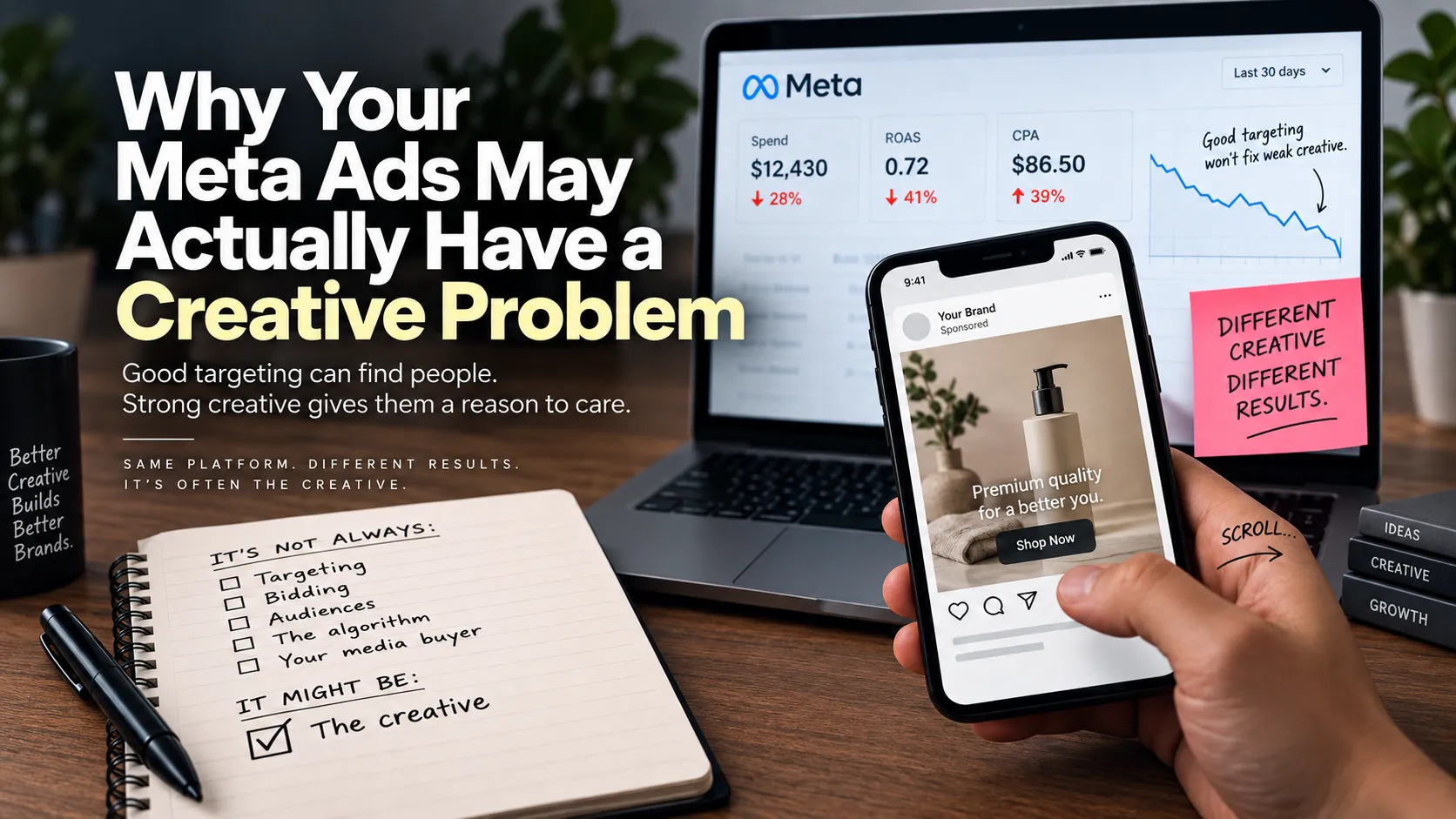
When a Meta Ads account starts underperforming, the reflex is almost always the same: restructure the campaign, adjust the bid strategy, rebuild the audience, check attribution, blame iOS, blame the algorithm, blame the media buyer.
Rarely does anyone open the ad itself and ask: is this actually worth someone’s attention?
That question gets skipped constantly — and it’s often the one that matters most. In many accounts I’ve diagnosed, the media buying was never broken. The creative was quietly failing, and the account structure was just the thing getting blamed for it.
This isn’t “creative is king.” That statement is empty because it doesn’t explain how creative breaks a system, and it doesn’t tell you what to do about it. This article does both.
The symptoms everyone blames on media buying
Here’s what a struggling account usually looks like on the surface:
- CPMs creeping up month over month
- CTR declining even though targeting hasn’t changed
- CAC rising while ROAS slides
- New audiences failing to convert the way old ones did
- Retargeting quietly propping up the entire account
- Frequency climbing while results get worse
- An ad that performs well for ten days, then collapses
- Constant campaign restructuring that never quite fixes it
Every one of these can be a media buying issue. But every one of these is also a textbook symptom of exhausted, repetitive, or poorly positioned creative — and the two get confused constantly, because the campaign dashboard doesn’t distinguish between “the algorithm can’t find your audience” and “the algorithm found your audience and your audience didn’t care.”
That distinction matters more than almost anything else in the account.
Meta cannot optimize its way out of an unpersuasive ad
Here’s the uncomfortable part: a campaign can have correct tracking, broad and well-built targeting, proper conversion optimization, clean account structure, and enough budget to give the algorithm real signal — and still fail, because the ad itself doesn’t make anyone care.
Meta’s delivery system is genuinely good at finding people who are statistically likely to engage with a given piece of content. What it cannot do is manufacture a reason for a stranger to stop scrolling, understand an offer, and believe it’s worth their money. That part isn’t a machine-learning problem. It’s a persuasion problem, and persuasion is a creative discipline, not a bidding strategy.
You cannot media-buy your way out of creative nobody wants to watch.
Every optimization Meta runs — audience expansion, budget allocation, placement selection — is downstream of one input: how people respond to the ad. If that input is weak, no amount of structural sophistication upstream fixes it. The algorithm optimizes distribution. It doesn’t optimize desire.
Creative affects more than CTR
Most advertisers still mentally file creative under “the thing that affects click-through rate.” That’s a significant underestimation of what creative is actually doing.
Creative shapes the entire performance chain:
- Thumb-stop rate — whether the pattern interrupt actually works in the first half-second
- Hook rate — whether the opening premise earns three more seconds
- Hold rate — whether the middle of the ad sustains the promise made in the hook
- CTR — whether the message and offer are compelling enough to act on
- Landing page visitor quality — whether the people clicking through are actually the right people, primed correctly
- Conversion rate — whether expectations set in the ad match what they find on the page
- CAC and ROAS — the compounding result of everything above
- Audience expansion and frequency — how far a message can travel before it exhausts itself
- Scaling potential — whether the concept can absorb more budget without collapsing
Notice that creative shows up on both sides of the click. Weak creative doesn’t just mean fewer people click — it often means the wrong people click, at higher cost, with lower intent, which shows up later as a conversion rate problem that gets misdiagnosed as a landing page or offer problem. The click is not where creative’s job ends. It’s roughly the halfway point.
Creative fatigue is not just “it’s been running too long”
“This ad is fatigued, we need fresh creative” is one of the most common — and most incomplete — diagnoses in performance marketing.
Fatigue isn’t purely a function of runtime. It’s a function of message repetition, and an account can be message-repetitive while looking creatively diverse on the surface. This happens when:
- The audience has seen the same underlying idea, repackaged
- Ten “different” ads are actually one concept in ten edits
- Hooks change, but the argument underneath stays identical
- The team keeps producing variations instead of new concepts
- The creative library has volume but no message diversity
This is the difference between creative variation and creative concept diversification — and it’s the single most under-diagnosed issue in accounts that feel “fatigued” despite constant new uploads.
More creatives is not automatically the fix
The natural response to fatigue is “let’s make more content.” That instinct is usually only half right.
More output does not automatically mean more creative diversity. A brand can produce fifty ads in a quarter and, on inspection, actually be running three ideas wearing different outfits.
To see why, it helps to separate creative into five distinct layers:
Angle → Concept → Hook → Execution → Variation
- Angle: the strategic lens — e.g., convenience
- Concept: the specific argument built on that angle — e.g., “Your current morning routine wastes 45 minutes you don’t have.”
- Hook: the opening line that earns attention — e.g., “Your morning routine shouldn’t take this long.”
- Execution: the format carrying the concept — e.g., founder talking head, UGC testimonial, demo, meme format
- Variation: surface-level edits — first three seconds, caption, CTA button text
Most “creative testing” only happens at the variation layer. Teams swap a hook, change a caption, try a new thumbnail — and call it a new test. But if the angle and concept never change, they’re testing packaging, not persuasion. Genuine creative testing has to happen higher up the hierarchy, at the angle and concept level, or the account is really just running the same experiment with a new coat of paint.
Winning ads tell you something — if you’re listening
The instinct after a winning ad is usually to scale it and move on. That’s a missed opportunity. A winning ad is market research that already happened — treating it only as a media-buying event wastes the signal.
Ask what it’s actually revealing:
- Which pain point resonated?
- Which desire did people respond to?
- Which objection did it quietly neutralize?
- Which awareness level was it speaking to?
- Which proof mechanism made it believable — data, demonstration, social proof, authority?
- Which format made the message land — talking head, UGC, static, demo?
Creative testing done well generates customer intelligence, not just a leaderboard of winning ad IDs. The account that treats every test as a data point about the market — not just about the ad — builds a compounding advantage over one that just chases the next winning creative in isolation.
Build creative around awareness, not just product features
Eugene Schwartz’s five stages of awareness are old, but most Meta accounts still violate them constantly:
- Unaware — doesn’t know they have the problem
- Problem aware — feels the pain, hasn’t found a name for it
- Solution aware — knows solutions exist, hasn’t picked one
- Product aware — knows your product, hasn’t decided to buy
- Most aware — ready to buy, just needs the nudge
Weak accounts speak almost exclusively to the last two stages — “Shop now,” “20% off,” “Our bestseller” — which only resonates with people who already know they want this exact category of solution. That’s a small, and shrinking, slice of the addressable market.
A skincare brand selling to product-aware customers says: “20% off our bestselling serum.” A skincare brand speaking to problem-aware customers says: “Why your expensive moisturizer isn’t fixing your dry skin.”
The second version doesn’t mention the product at all in the hook — and that’s exactly why it reaches further. It opens a loop for anyone frustrated with dry skin, regardless of whether they’ve ever heard of the brand, and lets the rest of the ad walk them toward the solution. It creates new demand instead of only harvesting demand that already exists. This is precisely why broadening creative messaging across awareness levels — not just broadening targeting — is what actually lets Meta convert larger portions of a market.
The same logic applies outside e-commerce. A SaaS company selling project management software to product-aware buyers says “Try our new dashboard.” Speaking to problem-aware buyers, it says “Your team is losing hours every week to status update meetings that shouldn’t need to exist.” A high-ticket service business — say, a fractional CFO — selling to the most-aware segment says “Book a consult.” Speaking to problem-aware founders, it says “Most founders find out they’ve been pricing at a loss six months too late.” Same business, radically different reach, because the message meets people where they actually are.
Creative saturation vs. audience saturation
These two get confused constantly, and they require opposite responses.
Audience saturation means the reachable market has genuinely been exhausted — there’s no meaningfully larger pool left to show ads to.
Creative saturation means the audience isn’t exhausted at all — but your current reasons for them to pay attention are. The pool of prospects is still there; what’s gone is the novelty of your current message.
Most accounts that believe they’ve “maxed out” their market have actually maxed out their current angle. Introducing a genuinely new concept — not a new edit — often reopens performance in an audience that looked dead a month earlier. Restructuring the campaign in that situation doesn’t fix anything, because the campaign was never the constraint.
A diagnostic framework: read the funnel, not one metric
No single metric proves a creative problem on its own — diagnosis requires reading the full funnel together. As a starting framework:
- CPM is high → investigate whether the creative earns attention relative to competition and market relevance, not just bid competition
- Thumb-stop is weak → the visual pattern interrupt or hook is likely failing before the message even gets a chance
- Hold rate collapses mid-ad → the opening promise isn’t being sustained through the body of the creative
- CTR is weak → the message, offer, or curiosity gap probably isn’t compelling enough
- CTR is strong but conversion rate is poor → look at message-market alignment, whether the click matched the landing page’s promise, and whether the offer holds up under scrutiny
- An ad wins but won’t scale → the concept may only appeal to a narrow segment of the market, not a broad one
- Performance dies quickly → check creative novelty and message diversity before assuming simple runtime fatigue
Each of these narrows down where in the chain attention or belief is breaking — which is far more useful than a blanket “let’s refresh creative” response.
What a real performance creative system looks like
High-performing brands aren’t simply “making ads” faster than everyone else. They’re running a repeatable system:
Customer research → insight mining → angle development → concept development → hook creation → production → testing → performance analysis → learning → iteration → new concepts
This loop treats performance creative as its own discipline — sitting at the intersection of brand, consumer psychology, direct response, content, media buying, and CRO. It’s not a content calendar. It’s closer to a research function that happens to produce ads as its output.
The better question
When an account struggles, the instinctive question is: “What campaign setting should we change?”
Often, the better question is: “What new reason have we given the market to care?”
Media buying decides who sees your message. It has never been able to decide whether that message deserves their attention — and it never will.
Meta can distribute your message. It cannot make the message worth paying attention to.